Table of contents
To navigate this article, you can use the links below to jump directly to specific sections.
- Introduction
- A Quick Refresher on GMP
- The Role of Digital Display in GMP Environment
- From Vision to Validation: Best Practices for Implementation
- Conclusion: Building a Culture of Compliance
Introduction
Bridging the Communication Gap in Manufacturing
In the world of manufacturing, where every detail matters, how do you ensure that your entire workforce is always on the same page? From the plant floor to the packaging line, keeping every employee aligned with the latest quality and safety standards is a big task. But it is not just about compliance; It’s about maintaining a culture where quality and safety are a high priority.
The Challenge of The Current Communication Methods
In manufacturing, relying on traditional methods like printed notices, a centralized computer for information, or mass emails can create a communication gap. These static, or often-inconvenient, methods are easily overlooked by employees on the fast-paced production floor. As an example, if a new safety procedure is announced only by email, a non-desk worker may not see it in time, potentially leading to a compliance violation or, worse, an injury.
The Solution – Digital Display Boards
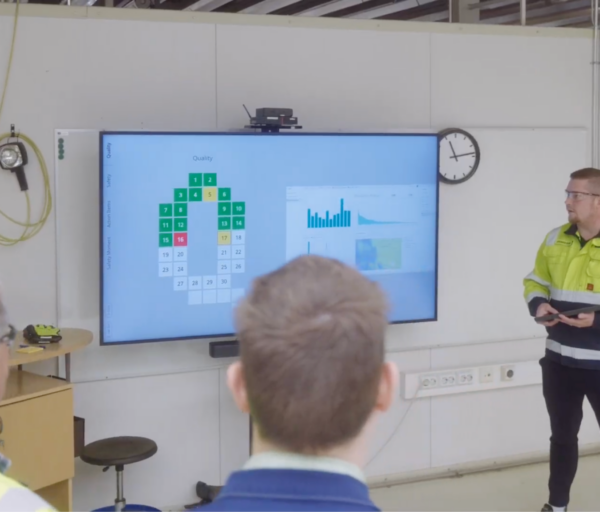
Digital display boards, often called Digital Signage Software, offer a powerful alternative to the previously mentioned methods by bringing critical information directly to the point of work. These digital screens provide real-time updates on key metrics and alerts, ensuring every employee has the information they need exactly when they need it. And what’s best, without having to stop their task or search for a notice.
While digital display boards are not a GMP-compliant system themselves, their strategic use is essential for supporting a culture of quality and compliance.
A Quick Refresher on GMP
What is GMP
GMP stands for Good Manufacturing Practice, sometimes also known as Current Good Manufacturing Practices (CGMP). It is a system to ensure products are consistently produced and controlled according to quality standards. This system is designed to proactively minimize risks such as contamination, mix-ups, and errors that can’t be eliminated through final product testing alone. It governs every aspect of the production process, from the materials and personnel to the facilities, equipment, and documentation.
GMP is mandatory for industries where product quality is critical for public health. The industries that use GMP Compliance are: Pharmaceutical, Food & Beverage, Medical Devices, and Cosmetics.*
The “5 P’s” of GMP
The “5 P’s” of GMP provide a simple and effective framework for understanding the regulations. By focusing on these core areas, a company can ensure that every aspect of its operation, from employee training to product packaging, consistently meets the standards for quality and safety.
- People: Well-trained, knowledgeable, and competent employees.
- Processes: Clearly defined, documented, and consistently followed procedures.
- Premises: A clean, well-maintained, and controlled facility.
- Products: Consistent quality from raw materials to finished goods.
- Procedures: Standardized, well-documented instructions for every task.
A well-planned and well-executed digital signage strategy directly supports these core GMP principles. Now, let’s dive into this.
The Role of Digital Displays in a GMP Environment
While digital display boards are excellent for showcasing live metrics and dynamic dashboards, they are also a critical communication channel for the shop floor. For example, instead of a static “Safety First” poster, a digital screen can show a live “Accident Free Days” counter, celebrate recent safety milestones, or dynamically display the latest announcements via SharePoint integration.

Aligning Digital Displays with the 5 P’s of GMP
In this section will explain how specific digital signage features directly align with each of the 5 P’s of GMP.
- Supporting “People”:
- Displaying Accident Free Days Counter
- Live Training and Reminders: Displaying bite-sized training videos and reminders for recurring training.
- Emergency Alerts: A system for instant, facility-wide alerts for safety or quality incidents.
- Supporting “Processes”:
- Supporting “Premises”:
- Housekeeping Reminders: Scheduled messages about cleaning schedules and sanitation protocols.
- Supporting “Products”:
- Quality Metrics: Displaying real-time quality control data and a counter showing “days since last deviation.”
- Supporting “Procedures”:
- Documentation Guidance: Reminders about the importance of accurate and legible documentation.
- Companies such as Valotalive can provide interactivity via their Control App for going through PDFs or Presentation documentation.
From Vision to Validation: Best Practices for Implementation
Implementing a digital signage system in a GMP-regulated facility requires a thoughtful, strategic approach. It’s not enough to simply hang a screen on a wall; the system must be integrated into the company’s quality culture and its validated processes.
Content Strategy – Integrations are key
The content is what makes the system valuable. A successful strategy is built on content update automation via integrations. Integrating with live data sources ensures the information on your screens is always relevant and up-to-date, minimizing the need for manual posting. This not only saves time and money, but also guarantees that outdated content never clutters your displays.
The goal is to display live content that can be understood quickly, without requiring a worker to stop their task.
Hardware and Placement
Choosing the right hardware is important. In a manufacturing environment, a consumer-grade television won’t last long. Instead, opt for industrial-grade displays designed to withstand the heat, dust, and vibrations of a production floor. Proper placement is also essential. Screens should be mounted in high-visibility areas, such as the entry to a work cell or at a shift change station.
A digital signage system is only as effective as the people who manage it. It’s crucial to train the admins and content creators and assign clear ownership for the system. This guarantees that the information displayed is always accurate and relevant, directly supporting GMP.
The Compliance View
Finally, from a compliance perspective, the use of a digital signage system must be documented and controlled. A digital display board is only as effective as the people who manage it. It’s crucial to train the admins and content creators and assign clear ownership for the system. This guarantees that the information displayed is always accurate and relevant, directly supporting GMP.
Conclusion: Building a Culture of Compliance
Digital display boards transform GMP compliance from a rigid requirement into a dynamic, visible, and engaging part of daily operations. This not only helps with regulatory audits but also improves productivity, safety, and employee engagement.
* While the core principles of GMP are universal, the regulatory bodies and their enforcement strategies have distinct differences:
- In the United States, the Food and Drug Administration (FDA) enforces a framework known as Current Good Manufacturing Practice (cGMP). Link & Link
- In the EU, GMP is a legal prerequisite for manufacturing and importing medicinal products. Link & Link
- The WHO’s role is not that of a national regulator. Instead, it serves as a global authority that provides foundational guidance. Link